Regional SEO & Search Advantage
Search engines do not organize information randomly.
They organize it according to relevance.
One of the strongest signals of relevance has always been geography.
People rarely search without context.
They search for services near them.
Businesses within specific markets.
Regional opportunities.
Local regulations.
Nearby suppliers.
Destination information.
Professional expertise.
Even when geography is not explicitly mentioned, it frequently remains part of the search intent.
Modern search systems increasingly recognize this relationship.
Location influences interpretation.
Language influences relevance.
Context influences ranking.
The result is a search environment where geography has become one of the fundamental organizing principles of digital discovery.
Professional organizations therefore understand that regional domains represent considerably more than keyword combinations.
They represent structured geographic relevance.
This distinction fundamentally changes how regional digital assets should be evaluated.
A regional domain is not simply attempting to rank for search queries.
It naturally aligns with the geographic structure through which users already search, businesses already operate, and markets already organize themselves.
Professional investors therefore recognize that regional search advantage rarely originates from technical optimization alone.
It develops through alignment.
Alignment between geography and user intent.
Between location and commercial activity.
Between digital identity and real economic ecosystems.
This explains why geographic relevance continues increasing in strategic importance even as search technology becomes increasingly sophisticated.
Artificial intelligence changes how information is interpreted.
It does not eliminate the importance of where that information belongs.
The stronger the geographic relationship, the stronger the contextual relevance often becomes.
Regional domains therefore create long-term strategic value not because they manipulate search engines.
They organize digital information according to the same geographic structures through which real economies already function.
Modern Search Systems Interpret Geographic Identity Through Multiple Signals
Modern search systems no longer evaluate websites through keywords alone.
They combine multiple machine learning systems responsible for understanding language, entities, geography, quality, trust, and user intent.
Professional organizations therefore recognize that geographic domains may benefit from stronger semantic alignment when the digital identity accurately reflects the real-world market it represents.
Several publicly documented Google systems contribute to this broader interpretation.
RankBrain helps interpret ambiguous queries and user intent, particularly when the search may have multiple possible meanings.
Neural Matching improves Google’s ability to associate search queries with concepts rather than relying exclusively on identical words.
BERT analyzes natural language context, allowing search systems to better understand how words relate to one another within a query.
MUM (Multitask Unified Model) expands contextual understanding across languages, formats, and information sources, helping Google interpret increasingly complex search behavior.
The Knowledge Graph connects entities such as cities, countries, organizations, landmarks, and industries into structured relationships that improve contextual understanding.
Location systems, including geotargeting, further adapt search results according to user location, language preferences, regional settings, and local intent.
Search quality systems also evaluate trust.
Google’s SpamBrain identifies large-scale spam patterns and manipulative behavior using machine learning.
Its primary purpose is protecting search quality rather than rewarding exact-match geographic domains.
Together, these systems attempt to answer one fundamental question:
“Which result most accurately represents what this user is trying to find?”
When two websites demonstrate comparable technical quality, content quality, authority, and user experience, a domain whose identity naturally aligns with the searched geographic entity may provide stronger semantic clarity.
This does not represent a guaranteed ranking advantage.
Rather, it reduces ambiguity.
Professional organizations therefore understand that geographic domains should not be viewed as shortcuts for search rankings.
They should be viewed as digital identities that naturally communicate contextual relevance to modern retrieval systems.
As search engines increasingly evolve toward entity understanding, semantic retrieval, and AI-assisted interpretation, this contextual alignment becomes progressively more valuable across the broader digital ecosystem.
A Thought Experiment in Semantic Search
Imagine two websites launched under identical conditions.
Both domains are registered on the same day.
Neither has backlinks.
Neither has previous authority.
Both use the same hosting environment.
Both publish the same landing page.
The same technical SEO.
The same page speed.
The same metadata.
The same content structure.
The same keyword targeting.
The only difference is the domain itself.
One is called Berlin.de.
The other is afpj33rf-5rbvt-vrte-v4rv.com.
Now imagine a user located in Berlin searching simply for:
“Berlin”
Professional organizations recognize that modern search systems evaluate considerably more than technical SEO.
They interpret entities.
Context.
Language.
Geographic relevance.
User intent.
Semantic relationships.
A domain such as Berlin.de immediately communicates a clear relationship with a globally recognized geographic entity.
Its identity naturally aligns with the user’s query.
The alternative domain communicates no meaningful semantic information through its name alone.
This does not guarantee that Berlin.de will automatically outrank every competing website.
Search quality continues depending on hundreds of additional ranking systems, including authority, content quality, user engagement, technical performance, and trust.
However, under this controlled thought experiment – where every measurable factor is intentionally identical—the domain whose identity most clearly reflects the searched geographic entity would generally be expected to provide stronger semantic alignment for modern retrieval systems.
Professional organizations therefore understand that a domain name is more than a technical identifier.
It contributes contextual information before the first paragraph is read.
Before the first backlink is earned.
Before user behavior begins influencing rankings.
The digital identity itself becomes part of how modern search systems interpret relevance.
As search continues evolving toward entity understanding, contextual retrieval, and AI-assisted ranking, semantic clarity becomes increasingly valuable.
The objective is therefore not simply selecting a memorable domain.
It is selecting a digital identity that naturally communicates the market, geography, or industry the platform is intended to represent.
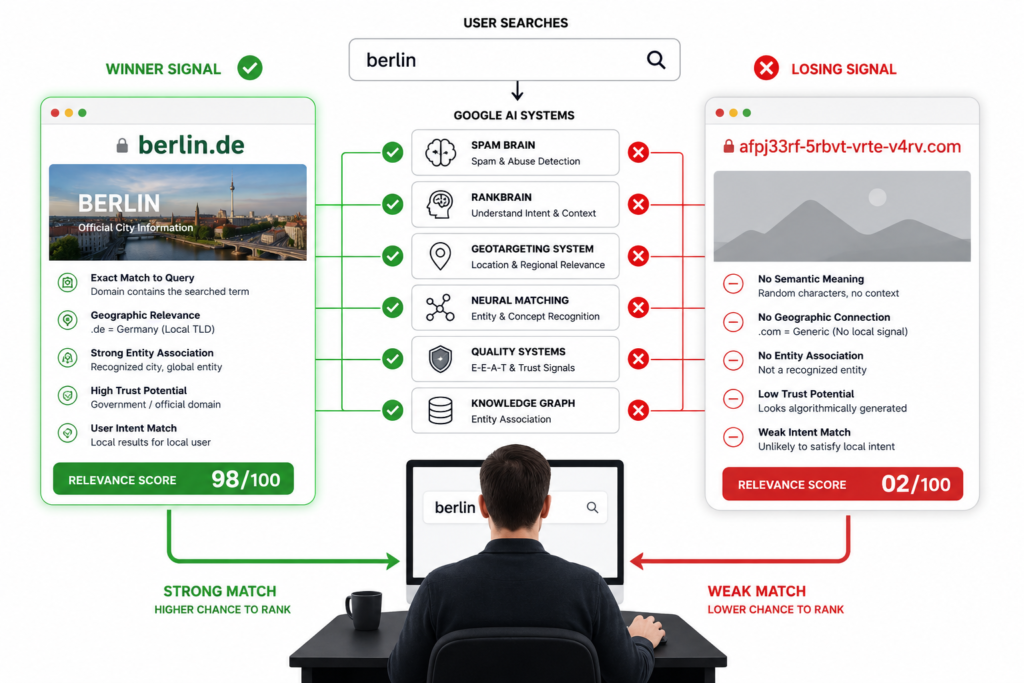
Illustration: TheGatekeeping.com
Perceptual Trust & the Power of Premium Geographic Domains
Search rankings determine visibility.
Human perception determines action.
These are two different processes.
A search engine decides which results appear.
The user decides which result deserves attention.
Professional organizations understand that this second decision often occurs within a fraction of a second.
Before a visitor reads the content.
Before evaluating the company.
Before comparing services.
Before understanding the business model.
The domain name itself becomes one of the earliest cognitive signals.
Imagine two search results appearing on the same page.
One displays a clear geographic identity.
The other displays a long, random sequence of characters with no recognizable meaning.
Even before clicking, the human brain begins evaluating familiarity.
Recognition.
Clarity.
Credibility.
Context.
People naturally process recognizable words faster than random character strings.
A geographic name immediately activates existing mental associations.
The visitor already understands the location.
Already recognizes the context.
Already possesses a mental model of what the website is likely to represent.
The alternative requires interpretation before trust can even begin to develop.
This phenomenon is well understood within cognitive psychology.
Recognition reduces cognitive effort.
Reduced cognitive effort frequently increases confidence.
Confidence influences attention.
Attention influences decisions.
Professional organizations therefore recognize that premium geographic domains contribute more than technical identity.
They contribute perceptual clarity.
This does not guarantee that users will trust the platform.
Nor does it guarantee higher rankings.
Trust is ultimately earned through quality, accuracy, transparency, and consistent user experience.
However, a clear geographic identity often reduces the initial uncertainty that exists before the first interaction takes place.
This explains why governments, public institutions, destination organizations, and many established businesses prefer digital identities that immediately communicate where they belong.
The objective is not simply memorability.
It is immediate recognition.
Recognition creates familiarity.
Familiarity lowers cognitive friction.
Lower cognitive friction increases the likelihood that users will continue exploring rather than returning to the search results.
Professional investors therefore understand that premium geographic domains create value on two independent levels.
The first is algorithmic relevance.
The second is human perception.
Modern digital strategy requires both.
Because successful digital assets must communicate clearly not only to search systems—but also to the people those systems ultimately serve.
Premium geographic domains reduce cognitive friction by communicating immediate contextual clarity to both digital systems and human decision-makers.
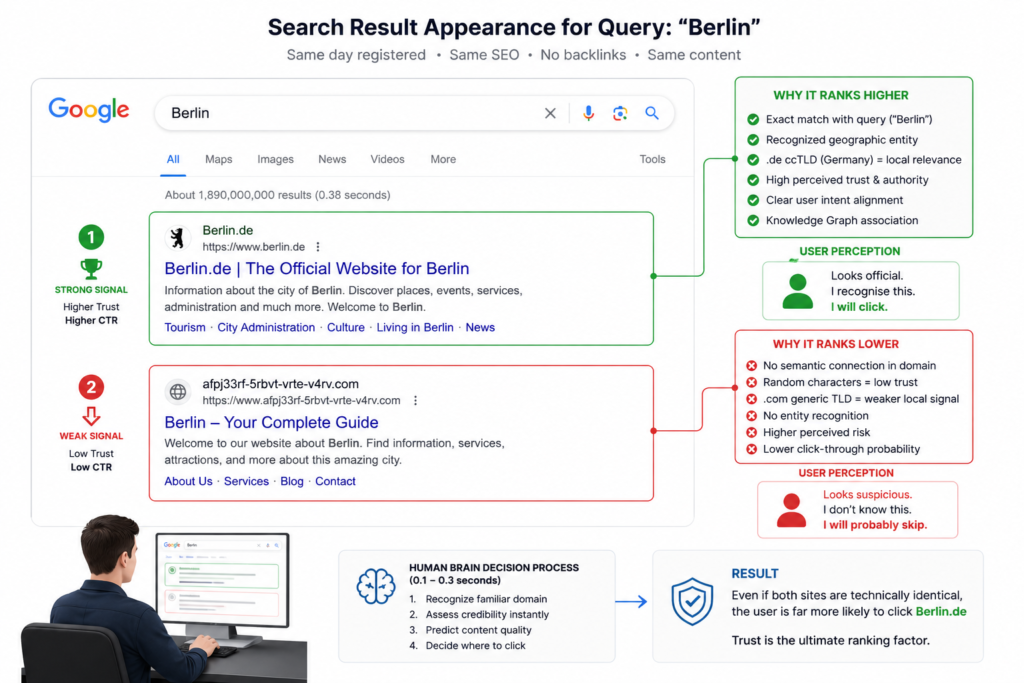
Illustration: TheGatekeeping.com
Search Behavior Naturally Follows Geography
People rarely begin with technical language.
They begin with practical objectives.
Finding a service.
Exploring a destination.
Comparing local businesses.
Evaluating investment opportunities.
Understanding a regional market.
Every search contains context.
Geography frequently provides that context.
Professional organizations recognize that this behavior has existed long before search engines.
People naturally think in locations.
Cities.
Regions.
Countries.
Neighborhoods.
Industrial districts.
Tourism destinations.
Commercial corridors.
Search technology has gradually evolved to understand these natural patterns rather than replace them.
Regional domains therefore benefit from something more durable than temporary optimization techniques.
They align with how people already organize information in everyday life.
This distinction explains why geographic relevance continues strengthening as search becomes increasingly semantic, contextual, and AI-assisted.
Professional investors therefore evaluate regional domains according to their ability to represent authentic market context rather than isolated keyword opportunities.
Because search increasingly rewards understanding.
Not simply matching words.
Regional Relevance Extends Beyond Traditional Search
Regional relevance is no longer evaluated exclusively by search engines.
The digital ecosystem has expanded considerably.
Artificial intelligence systems interpret context.
Digital assistants answer location-based questions.
Business platforms recommend regional providers.
Navigation services organize commercial destinations.
Travel platforms evaluate local experiences.
Professional directories classify industries geographically.
The common principle remains unchanged.
Every system attempts to understand where information belongs.
Professional organizations therefore recognize that regional domains increasingly support digital discoverability across multiple technologies rather than one search engine alone.
The objective is not simply achieving higher rankings.
It is establishing a clear geographic identity that multiple digital systems can consistently recognize.
This distinction fundamentally changes long-term strategy.
Optimization gradually becomes organization.
Instead of asking how to rank for a keyword, professional organizations increasingly ask how to represent a regional market as accurately as possible.
The stronger that representation becomes, the easier it becomes for digital platforms to understand the ecosystem surrounding it.
Businesses.
Industries.
Communities.
Infrastructure.
Tourism.
Investment.
Services.
Each contributes additional contextual relevance.
Professional investors therefore understand that regional domains frequently become stronger as surrounding digital ecosystems become richer.
The domain itself remains unchanged.
Its contextual significance continues expanding.
Regional Domains Strengthen Market Discoverability
Every regional economy produces enormous amounts of information.
Businesses launch.
Industries expand.
Infrastructure develops.
Events are organized.
Communities grow.
Investment increases.
Professional organizations recognize that information alone rarely creates opportunity.
Discoverability does.
If businesses cannot be found, commercial activity slows.
If suppliers remain invisible, partnerships become more difficult.
If investors cannot understand the regional economy, capital often flows elsewhere.
Regional domains therefore perform an important organizing function.
They reduce fragmentation.
Create structure.
Improve navigation.
Connect related information.
Strengthen commercial visibility.
The result is a market that becomes easier to understand for everyone participating within it.
Residents.
Visitors.
Businesses.
Government institutions.
International organizations.
Professional investors therefore evaluate regional digital assets according to the clarity they bring to an economic ecosystem.
The strongest platforms organize information in ways that naturally reflect how the regional economy already operates.
This creates lasting strategic value.
Because organized markets are easier to discover.
Easier to understand.
And ultimately, easier to participate in.
Regional Search Advantage Compounds Through Market Maturity
Search visibility may fluctuate.
Technologies will continue evolving.
Algorithms will continue improving.
User behavior will continue changing.
Regional economic development follows a different timeline.
Businesses accumulate.
Industries mature.
Infrastructure expands.
Communities strengthen.
Commercial relationships multiply.
Professional organizations understand that geographic digital assets frequently become stronger as these long-term developments continue.
Their strategic position improves because the market surrounding them becomes richer.
Not because the domain itself changes.
This distinction explains why experienced investors focus less on short-term ranking movements and more on long-term regional development.
A growing regional economy naturally produces more businesses.
More services.
More partnerships.
More investment.
More digital activity.
Each contributes additional relevance to the geographic ecosystem.
Professional investors therefore recognize that regional search advantage is ultimately the result of market maturity rather than isolated optimization.
Technology may determine how information is delivered.
Regional economic development determines how much valuable information exists to organize.
That relationship transforms regional domains from SEO assets into long-term components of digital market infrastructure.
Editorial Note on Google Search Systems
Throughout this article, references to Google Search, semantic understanding, AI retrieval, and ranking behavior are based on Google’s publicly documented Search documentation and officially described ranking systems. These include technologies and systems such as BERT, RankBrain, Neural Matching, SpamBrain, PageRank, Exact Match Domain systems, Passage Ranking, Freshness systems, Original Content systems, Reviews systems, Reliable Information systems, Site Diversity systems, Deduplication systems, as well as Google’s broader core ranking systems and page-level relevance signals.
TheGatekeeping does not claim access to Google’s proprietary ranking algorithms, internal weighting models, or confidential engineering documentation. Any discussion regarding premium domains, category-defining domains, semantic positioning, geographic relevance, digital assets, or structural market advantages represents independent editorial analysis designed to explain observable patterns within digital markets rather than Google’s unpublished ranking methodology.
Search visibility depends on hundreds of interacting signals, including page relevance, content quality, user intent, technical implementation, authority, links, site-level classifiers, semantic understanding, freshness, and many continuously evolving ranking systems. No individual characteristic.. including a premium domain name, an exact-match domain, geographic naming, or category-defining terminology – guarantees higher rankings or improved search performance on its own.
The Core Principle
Regional search advantage is created by accurately representing real economic ecosystems, allowing digital platforms to understand, organize, and connect geographic markets more effectively over time.
TheGatekeeping.com
© Index · System · Market Interface
Analytical Center for Digital Assets and Market Positioning