Before you proceed, understand this: The following analysis is not a sales pitch, nor is it a primer for the casual observer. This knowledge is specifically engineered for the owners of premium domains, domain experts, software developers and engineers, network architects, and high-level engineers, the professionals who build, secure, and navigate the structural foundations of the modern internet.
If you are looking for empty hype, “get-rich-quick” speculation, or surface-level market commentary, you are in the wrong harbor.
We operate in a environment where noise is constant and deception is a business model. This framework is designed for the minds that are nearly impossible to cheat. We do not trade in “empty stories” or aesthetic valuations. We map the raw, data-driven intersection of scarcity, structural necessity, and risk mitigation.
In this domain, value is a function of engineering, and ownership is a strategic position. If you lack the discipline to analyze the underlying systems, the gate remains closed.
Read with precision.
The Illusion of Value in Digital Assets
In the domain industry, valuation is often treated as a number. A price tag, a comparable sale, a negotiation outcome. This simplification is convenient, but it is fundamentally incomplete.
A domain name does not possess value in isolation. It exists within a dynamic system shaped by demand, context, timing, and structural positioning.
At any given moment, the same asset can be perceived as undervalued, fairly priced, or overpriced depending on who is evaluating it and under what conditions.
This fluidity creates a critical challenge. Without a structured framework, valuation becomes subjective, inconsistent, and highly vulnerable to error.
The industry is filled with surface-level indicators. Estimated values generated by automated tools. Listing prices set without context. Comparables selected selectively to justify expectations.
These signals create the illusion of precision. They do not provide actual clarity.
True valuation requires a different approach. It requires understanding how value is formed, how it evolves, and how it can be distorted.
The Structural Undervaluation of Digital Assets (Data-Driven Perspective)
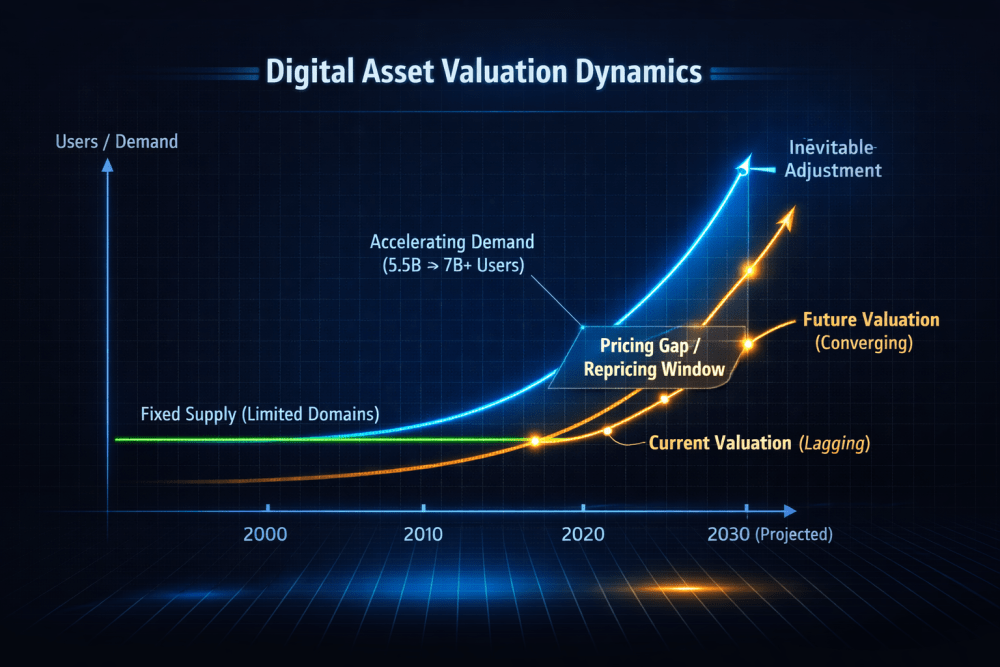
Current domain pricing exists within a market that reflects present conditions, not future scale. This creates a measurable gap between today’s valuations and the structural demand that is already forming.
As of 2025, approximately 5.5. billion people are active internet users, representing around 74% of the global population . Despite this scale, between 2 and 2.5 billion people remain offline, most of them in emerging markets where connectivity is still expanding .
Multiple forecasts converge on a single outcome: by 2030, global internet penetration is expected to approach 90% of the world’s population, resulting in approximately 7 billion connected users .
This implies the addition of 1.5 billion new users within the next decade.
This growth is not marginal. It represents one of the largest expansions of any economic system in modern history.
Demand Expansion vs Fixed Supply
Unlike user growth, domain supply does not expand.
The number of high-quality digital identifiers remains fixed.
There is only one exact-match category domain.
There is only one single-word .com per concept.
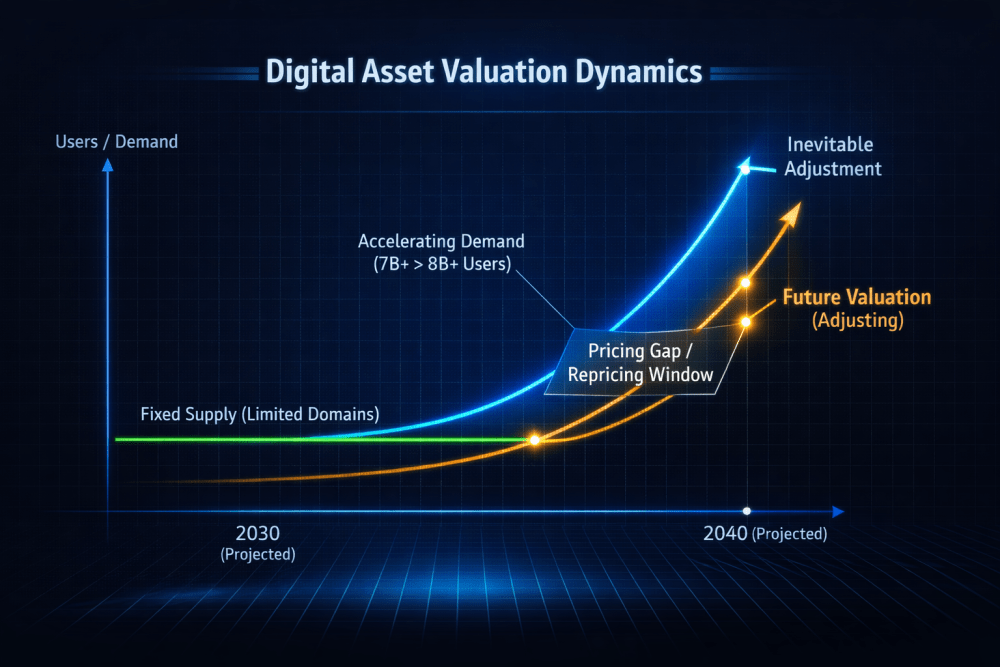
As the number of participants increases from 5.5 billion toward 7+ billion, competition for clear naming systems intensifies.
This creates a structural imbalance:
Demand is expanding exponentially.
Supply is permanently constrained.
In economic terms, this is a classic scarcity model under accelerating demand conditions.
The Economic Layer Behind Digital Growth
The expansion of internet users is directly linked to economic output.
By 2030, mobile and digital technologies are projected to contribute over $11 trillion to the global economy, up from approximately $7.6 trillion today .
At the same time, the number of connected devices is expected to reach 38–40 billion globally, creating a dense, always-on digital environment .
This means that digital interaction is no longer limited to users. It extends to systems, devices, and automated processes.
The result is a compounding effect:
More users → more economic activity
More devices → more interactions
More interactions → more need for structured digital identity
Domains sit at the center of that identity layer.
Mispricing as a Function of Market Maturity
Despite these projections, current domain pricing is still largely anchored in present-day demand.
The market continues to operate on:
- historical sales
- current buyer pools
- limited institutional participation
This creates a lag between structural value and market pricing.
In mature asset classes, future demand is priced in early.
In digital assets, it is not.
This gap defines the current opportunity.
The Inevitable Adjustment
As the global digital population moves toward 7+ billion users, the importance of clear, authoritative, and category-defining digital assets increases.
Businesses will compete for visibility.
Users will rely on clarity.
Markets will organize around recognizable structures.
Domains that already occupy these positions will not need to adapt.
They will simply absorb demand.
Pricing will not rise because of speculation.
It will rise because of structural necessity.
The Gatekeeping Final Opinion
From a data-driven perspective, the conclusion is direct:
Current domain valuations reflect a market of 5.5 billion users.
The next decade will operate in a market of 7 billion users.
The infrastructure remains the same.
The competition increases.
This creates a measurable misalignment.
Domains are not expensive relative to the future.
They are underpriced relative to the scale that is already forming.
The Foundations of Domain Valuation
Value as a Function of Structure
At its core, domain valuation is not about guessing what someone might pay. It is about identifying where an asset sits within the structure of the digital economy.
A domain derives its value from multiple dimensions. Linguistic quality, market relevance, commercial intent, memorability, and scarcity all contribute to its positioning.
However, these attributes only become meaningful when aligned with demand.
A short, memorable domain has potential value. A domain aligned with a high-growth industry has strategic relevance. A domain that matches a category-defining term has structural importance.
When these elements converge, value becomes visible.
When they do not, perceived value collapses.
This distinction separates assets from liabilities.
Market-Driven Reality
The Role of Demand
No valuation model exists outside the market.
Regardless of theoretical frameworks, the final expression of value is determined by demand.
This demand is not uniform. It is fragmented across industries, geographies, and buyer profiles.
A domain that is irrelevant to one buyer may be critical to another. A name that appears generic in one context may define an entire category in another.
This creates asymmetry.
The same asset can have dramatically different values depending on who is evaluating it and why.
Understanding this asymmetry is essential. It explains why domains are often sold at prices that appear inconsistent when viewed without context.
It also explains why some assets remain unsold for years while others transact quickly.
Value is not static. It is situational.
Comparative Sales and Their Limitations
The Misuse of Benchmarks
Comparative sales are frequently used as a reference point for valuation. While they provide useful context, they are often misunderstood.
A past sale reflects a specific transaction between specific parties at a specific moment in time. It does not represent a universal benchmark.
Differences in timing, buyer motivation, industry conditions, and negotiation dynamics can significantly impact the outcome.
Relying on comparables without adjusting for these variables introduces distortion.
The result is a common pattern. Sellers anchor to high-profile sales. Buyers discount them. Negotiations stall.
A structured approach recognizes comparables as one input among many, not as definitive proof of value.
The Role of Liquidity
Value Versus Marketability
An asset can have theoretical value while remaining illiquid.
Liquidity refers to the ability to convert an asset into cash within a reasonable timeframe without significant loss of value.
In the domain market, liquidity varies widely.
Ultra-premium domains may command high prices but require the right buyer. Mid-tier domains may transact more frequently but at lower values. Lower-quality assets may have limited or no liquidity.
This creates a trade-off.
High-value assets often come with longer holding periods. More liquid assets may offer lower returns.
Understanding this dynamic is critical for portfolio strategy.
Value without liquidity is potential.
Liquidity without value is inefficiency.
Risk as an Embedded Variable
The Other Side of Valuation
Every valuation inherently includes risk, whether acknowledged or not.
Risk influences not only the likelihood of a sale, but also the stability of ownership and the sustainability of value.
Ignoring risk leads to overvaluation.
Incorporating risk leads to more accurate positioning.
Risk is not a separate consideration. It is part of the valuation equation.
Categories of Risk in Domain Investment
Legal, Market, and Operational Exposure
Legal risk arises from potential disputes, trademark conflicts, and jurisdictional challenges.
Market risk is driven by changes in demand, industry shifts, and evolving trends.
Operational risk includes security vulnerabilities, registrar dependencies, and management errors.
Each category affects value differently.
A legally vulnerable domain may lose its value entirely.
A market-dependent domain may fluctuate.
An operational failure may result in asset loss.
Understanding these layers allows for more precise evaluation.
Legal Risk and Trademark Exposure
The Hidden Liability
A domain that conflicts with an established trademark carries inherent risk.
This risk is not always visible at the time of acquisition. It may emerge later, triggered by changes in usage, enforcement, or ownership.
Dispute mechanisms provide pathways for claims to be filed and enforced.
In some cases, domains are transferred without compensation.
This transforms a high-value asset into a total loss.
Legal due diligence is therefore not optional. It is a core component of valuation.
Market Risk and Demand Volatility
The Impact of Industry Shifts
Markets evolve.
Technologies emerge. Industries expand and contract. Consumer behavior changes.
Domains aligned with declining sectors may lose relevance. Domains aligned with emerging sectors may gain value.
However, timing is critical.
Entering too early can result in long holding periods. Entering too late can result in overpaying.
Market risk cannot be eliminated. It can only be managed.
Liquidity Risk
The Time Factor
Liquidity risk reflects the uncertainty of finding a buyer.
A domain may be correctly valued, yet remain unsold due to limited demand at a given moment.
This introduces time as a variable.
Holding costs accumulate. Opportunity cost increases.
Liquidity risk is often underestimated because it is not immediately visible.
However, it directly affects returns.
Operational Risk and Security
Control as a Vulnerability
Domains are controlled through digital systems.
Access credentials, registrar accounts, and DNS configurations represent points of vulnerability.
Unauthorized access, mismanagement, or technical failures can result in asset loss.
Security measures reduce this risk, but they do not eliminate it.
Operational discipline is required.
Reputation Risk and Brand Association
Perception as a Value Driver
A domain carries not only its name, but also its history.
Previous usage, associations, and reputational signals can influence how the asset is perceived.
Negative history can reduce value. Positive associations can enhance it.
This dimension is often overlooked in basic valuation models.
However, it becomes critical in high-value transactions.
Risk Mitigation as Strategy
From Exposure to Control
Risk cannot be removed from the system.
It can be understood, measured, and mitigated.
Mitigation begins with due diligence.
Understanding the legal status, historical usage, and market positioning of an asset reduces uncertainty.
Security practices protect operational control.
Portfolio diversification spreads exposure across different asset types and sectors.
Structured acquisition processes reduce the likelihood of error.
Mitigation transforms risk from an unknown variable into a managed parameter.
The Interdependence of Valuation and Risk
A Unified Framework
Valuation and risk are not separate processes.
They are interdependent.
Every increase in value must be evaluated against the associated risk.
Every reduction in risk can enhance perceived value.
This relationship creates a unified framework.
Accurate valuation requires risk assessment.
Effective risk mitigation supports valuation.
Portfolio-Level Perspective
Beyond Individual Assets
Focusing on individual domains provides limited insight.
A portfolio introduces additional dimensions.
Diversification reduces exposure to specific risks.
Asset allocation influences overall performance.
Holding periods, liquidity profiles, and valuation ranges interact to shape outcomes.
A structured portfolio balances these elements.
It is not defined by the number of domains, but by their composition.
The Role of Discipline
Decision-Making Under Uncertainty
The domain market rewards discipline.
Impulse-driven decisions increase risk.
Structured analysis reduces it.
Acquisition should be based on alignment between value, risk, and strategy.
This requires patience.
Time is not a constraint. It is a tool.
The Gatekeeping Perspective
Revealing Structure
Valuation and risk mitigation are often approached as separate disciplines.
In reality, they are part of a single system.
Understanding this system requires moving beyond surface-level indicators.
It requires analyzing how value is formed, how risk is embedded, and how both interact over time.
TheGatekeeping.com approaches this from a structural perspective.
It does not attempt to predict prices.
It does not promote assets.
It maps the conditions under which value emerges and risk is managed.
This perspective transforms how digital assets are evaluated.
Ownership becomes a strategic position within a system.
Value becomes a function of alignment with that system.
Risk becomes a measurable component of that position.
And The Final Gatekeeping Principle
Value without risk awareness is illusion.
Risk without valuation is paralysis.
Only their integration creates strategy.
The Gatekeeping Editorial
© Index · System · Market Interface
Analytical Center for Digital Assets and Market Positioning