Digital Demand
This page is not written to be short. It is written to make the structure impossible to ignore.
Digital Demand is the structural argument behind premium domain value.
Digital markets do not expand only because companies go online.
They expand because every new generation enters the internet earlier, stays there longer and treats digital environments as native territory.
Every year, new users enter the digital ecosystem.
Some discover platforms, games, apps, creators, tools, communities and online identities for the first time.
Some begin influencing household spending before they have full legal purchasing power.
Some become teenagers shaping demand through preference, attention, taste and cultural pressure.
Some become young adults with their first payment cards, digital wallets, trading accounts, subscriptions, gaming accounts, creator tools, business tools and direct purchasing ability.
Then they become founders.
They become buyers.
They become investors.
They become operators.
They become asset owners.
They become part of the market itself.
That is digital demand.
It does not arrive once.
It keeps arriving.
The Locked Supply Problem
The premium domain market has a simple structural tension.
Many of the strongest names were secured early.
The next wave of demand arrived later.
This is the part most people underestimate.
A founder may discover an idea in 2026, but the best digital name for that idea may have been unavailable since the 1990s.
A company may raise capital today, but the cleanest category domain may already be owned.
A new buyer may finally understand the value of a name, but the market position behind that name may have been locked for decades.
That does not mean demand disappeared.
It means demand arrived after supply was already constrained.
This is why premium domains behave differently from ordinary digital inventory.
More users can enter the internet.
More startups can launch.
More companies can digitize.
More investors can look for digital assets.
More buyers can search for better names.
But the strongest domain positions do not regenerate every year.
Once the exact name is owned, every later buyer enters a different market.
They are no longer competing against availability.
They are competing against ownership.
That is the locked supply problem.
The market can produce new demand every year, but it cannot produce a second exact category-defining domain.
This creates a long-term imbalance.
Hundreds or thousands of future buyers may want the same type of name over time.
Some may want it for a few thousand dollars.
Some may want it for tens of thousands.
Some may want it for hundreds of thousands.
Some may only understand its value after they are forced to choose a weaker alternative.
But if the strongest name is already controlled, the decision is no longer only about price.
It becomes a question of access.
The domain exists.
The demand exists.
But the open supply does not.
That is why the most important premium domains should be understood as locked digital positions, not merely available or unavailable website addresses.
They sit in the market before the next buyer arrives.
They wait while new users become founders, buyers, operators and investors.
And by the time many of them realize which name they wanted, the name is already part of someone else’s digital structure.
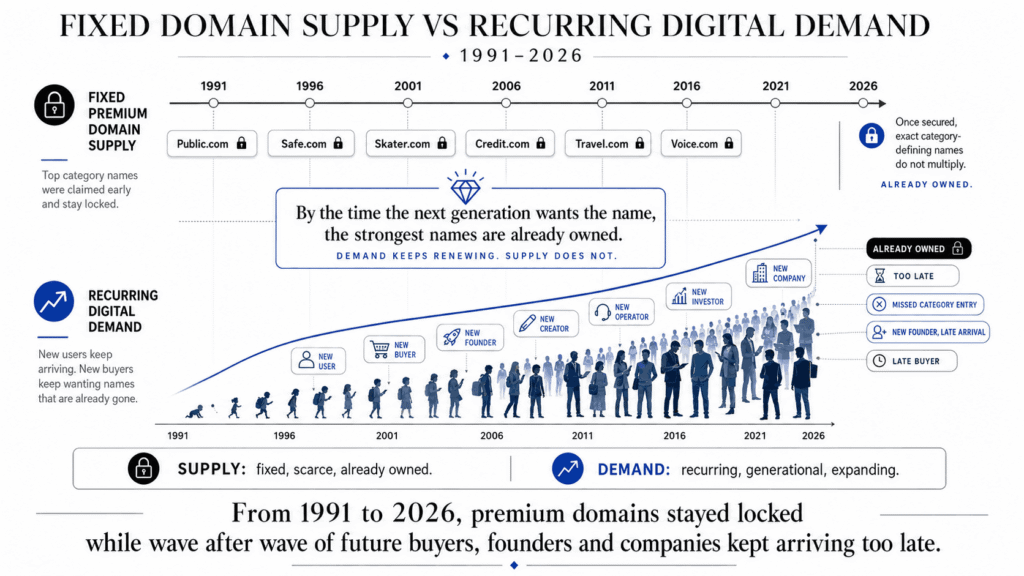
Illustration: TheGatekeeping.com
Category Quality Defines Domain Value
Fixed supply alone does not make every domain equally valuable.
The category matters.
A domain becomes stronger when the name sits inside a market with recurring demand, commercial depth, buyer activity, cultural relevance, trust requirements or long-term digital expansion.
This is why two short domains can have completely different strategic value.
A name connected to hotels is not the same as a name connected to dogs.
Both may be memorable.
Both may be simple.
Both may be category-relevant.
But the underlying category structure is different.
Hotels can connect to travel, bookings, tourism, hospitality, comparison, location demand, international search behavior, commercial intent, recurring transactions and high-value customer acquisition.
Dogs can connect to pets, culture, ownership, products, care, communities, training, food, insurance, media, lifestyle and emotional identity.
Both can be valuable, but not for the same reason.
One may carry stronger transactional demand.
The other may carry stronger cultural and consumer identity.
That is the point.
Premium domain value is not only about the word.
It is about the market behind the word.
A category-defining domain becomes more powerful when the category itself has durable demand, clear commercial use, repeated buyer behavior, emotional relevance or strategic importance.
The domain is the entry point.
The category is the engine.
This is why serious domain analysis must look beyond length, extension and memorability.
It must ask:
What category does the name control?
How much demand exists around that category?
Is the demand commercial, cultural, informational, emotional or strategic?
Does the category renew every year?
Do new users keep entering it?
Do companies keep spending inside it?
Do buyers understand it immediately?
Can the name become the natural digital center of that category?
That is where domain value becomes more precise.
A strong name in a weak category may still be useful.
A strong name in a powerful category can become infrastructure.
The best premium domains are not only scarce.
They are scarce inside categories that people, companies and markets continue to care about.
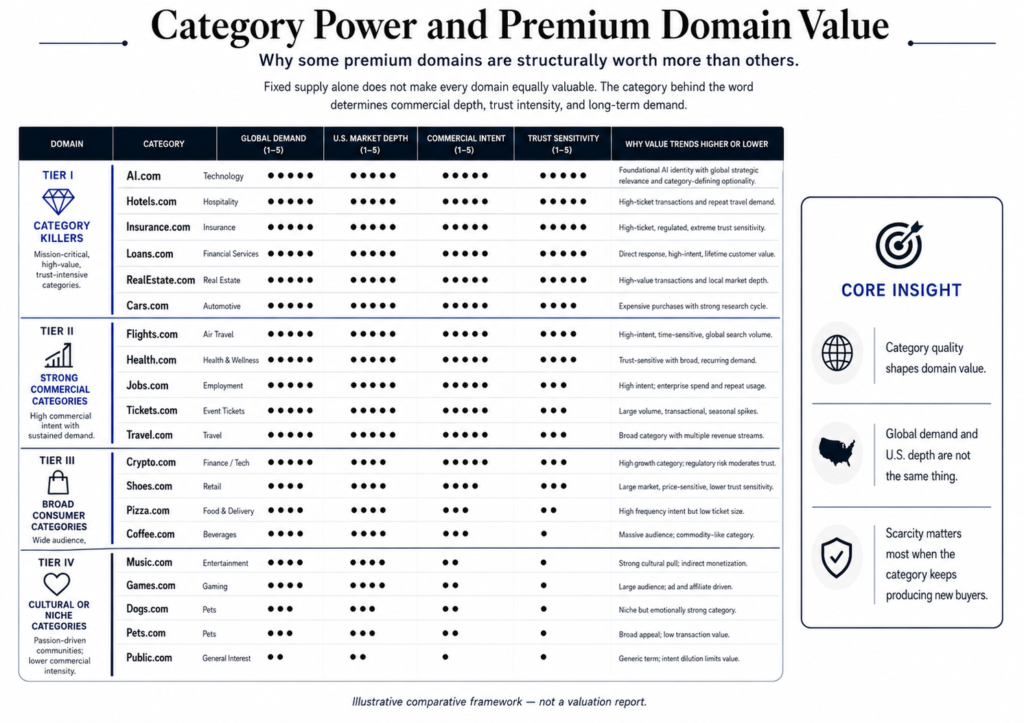
Illustration: TheGatekeeping.com
Global Coverage and Understandability
A premium domain does not carry the same strength in every market.
Its advantage depends on language familiarity, commercial behavior, digital maturity, category relevance, trust expectations and how easily the name can be understood across borders.
A domain such as Safe.com has unusual strategic reach because the word is short, simple, trust-loaded and widely recognizable.
It does not require a long explanation.
It immediately suggests protection, security, reliability, caution, privacy, access, safety, trust and risk reduction.
Those meanings travel well.
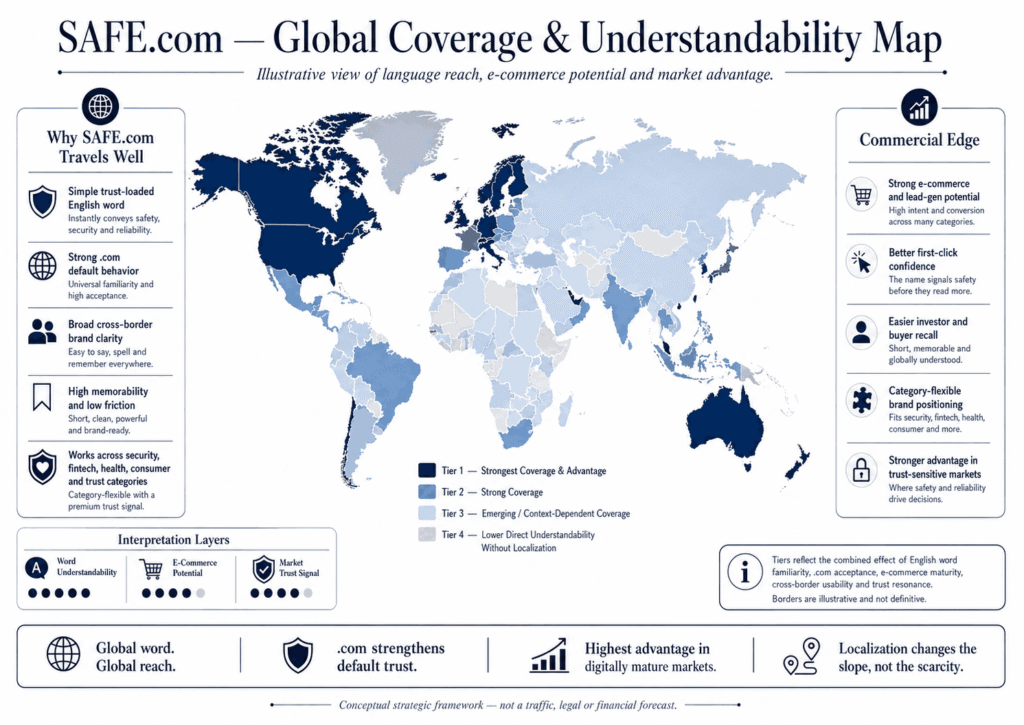
Illustration: TheGatekeeping.com
That is why a name like Safe.com can hold value across many markets at the same time.
In English-speaking countries, the meaning is direct.
In many digitally mature non-English markets, the word is still familiar enough to function as a strong international brand signal.
In global business environments, safe is easy to say, easy to remember and easy to connect with trust-sensitive categories.
This creates a broader market surface than a domain that only works inside one language, one region or one narrow cultural context.
The advantage is not only linguistic.
It is commercial.
A name like Safe.com can support cybersecurity, fintech, insurance, health, identity, privacy, payments, family protection, storage, consumer trust, enterprise risk and other categories where confidence matters before conversion.
That flexibility increases the domain’s strategic surface.
A buyer in the United States may see it as a security or fintech asset.
A buyer in Europe may see it as a trust or compliance-facing brand.
A buyer in the Middle East may see it as a premium digital protection signal.
A buyer in Asia may see it as a clean international identity.
The same name can serve different commercial interpretations while keeping one central meaning.
That is powerful.
The map does not mean every country has equal demand.
It does not mean every user understands the word at the same depth.
It does not mean the domain would perform the same way in every language or market.
Localization still matters.
Culture still matters.
Category fit still matters.
Execution still matters.
But the core advantage remains: Safe.com has a higher probability of being understood, trusted and remembered across many markets than a longer, weaker or more localized alternative.
That is what global coverage means.
It is not only geographic reach.
It is mental reach.
It is the ability of a name to cross borders, remain simple, keep its meaning and still feel commercially usable.
This is where premium domains become different from ordinary names.
A normal domain may work in one market.
A strong premium domain can travel.
And when the word is globally understandable, commercially flexible and attached to the strongest default extension, the domain becomes more than an address.
It becomes a portable trust signal.
Demand Starts Before the Payment
A thirteen-year-old may not yet be the legal buyer in a transaction.
But they can already shape demand.
They choose the game.
They choose the app.
They choose the creator.
They choose the platform.
They choose the product.
They choose the brand they want.
The parent may complete the payment, but the demand often begins earlier.
This matters because digital demand is not created only at the moment of purchase.
It begins when preference is formed.
It begins when attention is captured.
It begins when a name is remembered.
It begins when a user starts trusting one destination more than another.
That is why digital identity matters.
The brand name matters.
The domain matters.
The search result matters.
The first click matters.
The trusted digital entry point matters.
The Generational Demand Curve
Digital demand is generational.
New users enter.
They learn digital behavior.
They form preferences.
They influence spending.
They gain payment access.
They become independent buyers.
They join markets.
They start companies.
They build products.
They acquire assets.
They invest.
They search.
They compare.
They choose.
This cycle does not stop because today’s market feels crowded.
It continues because new people keep entering the digital economy.
A domain that is already taken today may still be taken ten years from now.
A category-defining name that is unavailable today may still be unavailable twenty years from now.
But the number of people who understand why that name matters can continue to grow.
That is the imbalance.
The supply of category-defining digital names is fixed or extremely limited.
The demand for digital identity keeps expanding.
The Name Is Already Gone
Imagine someone in 2026 wants to build around a name such as:
Public.com
or
Skater.com
or any other clean, memorable, category-relevant digital name.
The idea may be new to that person.
The ambition may be fresh.
The business plan may be serious.
The founder may be ready to build.
But the name is already gone.
That is the reality of premium digital naming.
The market does not wait for the next founder to arrive.
The strongest names were often registered, acquired, developed or locked years before the next wave of buyers understood their value.
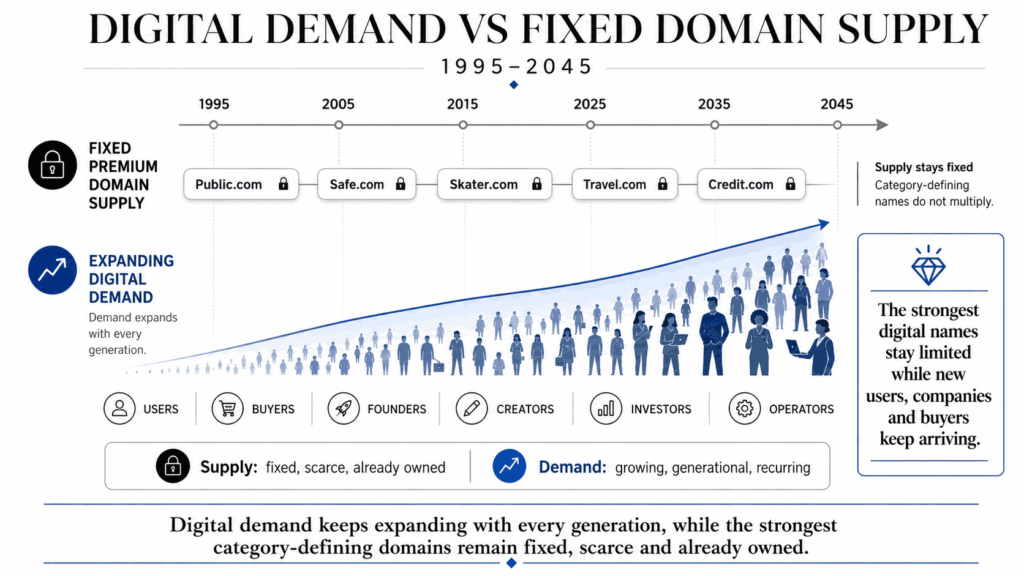
Illustration: TheGatekeeping.com
A new founder can still build.
They can choose another name.
They can add extra words.
They can use hyphens.
They can use numbers.
They can choose a weaker extension.
They can create a longer brand.
They can invent something completely different.
But they cannot recreate the exact clean digital entry point if someone else already controls it.
That is the supply problem.
Demand Does Not Disappear Because Supply Is Locked
The fact that the best name is already taken does not remove demand.
It only changes how demand behaves.
Some buyers give up.
Some choose alternatives.
Some negotiate.
Some wait.
Some buy weaker names.
Some build on longer names.
Some return years later with more capital.
Some understand too late that the name they wanted was not just a label, but a market position.
This is why premium domains cannot be evaluated only by today’s visible buyer.
There may be no buyer today.
There may be one buyer next year.
There may be ten buyers over the next decade.
There may be hundreds or thousands of people over twenty years who would want the same clean name if it matched their company, product, ambition, category or identity.
Not all of them can buy it.
Not all of them can afford it.
Not all of them will act.
But the demand can still exist.
The name remains limited.
The desire keeps regenerating.
The Twenty-Year View
A serious domain should not always be judged only by today’s traffic, today’s revenue, today’s search volume or today’s inquiry count.
Those signals matter.
But they are not the whole structure.
A category-level domain lives inside a longer market cycle.
Over the next twenty years, more people will enter digital markets.
More founders will launch companies.
More creators will build personal brands.
More industries will become software-driven.
More buyers will search online first.
More investors will evaluate digital identity.
More companies will need trusted names.
More AI systems will interpret entities, brands, domains and authority signals.
More markets will become dependent on digital access points.
During that same period, the strongest names do not multiply.
There will not be a second exact Public.com.
There will not be a second exact Skater.com.
There will not be a second exact Safe.com.
There will not be a second cleanest category name for the same idea in the same extension.
The demand curve can keep moving.
The supply remains locked.
That is the structural argument.
Premium Domains Are Digital Entry Points
A premium domain is not only an address.
It is a digital entry point.
It can become the place where a market understands a category, product, service, idea or company.
A strong domain can reduce explanation.
It can improve recall.
It can support trust.
It can make search results feel more credible.
It can strengthen investor perception.
It can help a company look more intentional.
It can make the brand easier to say, type, remember and share.
That does not guarantee business success.
A premium domain cannot replace execution.
It cannot create revenue alone.
It cannot make a weak product strong.
But it can give a serious operator a better starting position.
In markets where attention is crowded, that starting position matters.
The Supply Side Is Not Flexible
Digital demand is flexible.
New companies can appear.
New users can arrive.
New platforms can launch.
New categories can form.
New buyers can enter.
New industries can digitize.
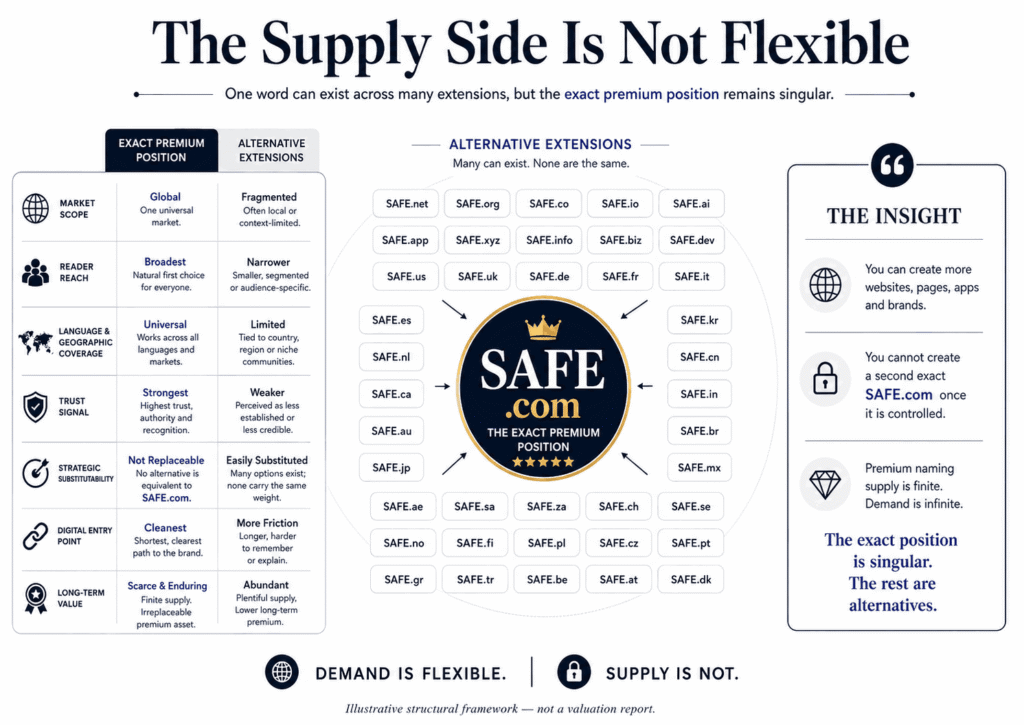
Illustration: TheGatekeeping.com
But premium naming supply is not flexible in the same way.
There is only one exact .com for a powerful term.
There is only one cleanest digital entry point.
There is only one strongest category name.
There is only one shortest version.
There is only one name that feels like the natural center of the idea.
Alternatives can exist.
But alternatives are not the same asset.
A longer domain may function.
A hyphenated domain may rank.
A creative brand may succeed.
A different extension may work.
But the exact premium position remains singular.
That is why domain scarcity is different from ordinary inventory.
You can build more websites.
You can publish more content.
You can create more landing pages.
You can launch more apps.
You can write more code.
But you cannot create a second exact category-defining domain once the first one is controlled.
Why This Creates Structural Undervaluation
Many premium domains may be structurally undervalued because the market often evaluates them through short-term logic.
What traffic does it have today?
What revenue does it produce today?
How many offers came this year?
What is the current search volume?
Who is the current buyer?
Those questions are useful, but incomplete.
A premium domain can also be evaluated through future demand pressure.
How many future founders may want this identity?
How many future products could use this name?
How many industries could adopt the concept?
How many users will enter the market over the next twenty years?
How many companies will need clearer digital trust?
How many buyers will prefer a cleaner name?
How difficult would it be to replace this exact position?
How many alternatives truly carry the same strength?
This does not mean every domain is valuable.
It does not mean every asking price is justified.
It does not mean every name deserves a premium valuation.
But it does mean that strong digital names should be analyzed through long-term demand, not only current usage.
Demand Is Not Always Visible
One of the mistakes in digital asset valuation is assuming that demand only exists when it is visible.
Visible demand is an inquiry.
Visible demand is an offer.
Visible demand is marketplace activity.
Visible demand is a sales conversation.
But latent demand may exist before any of those signals appear.
A future founder may not exist yet as a buyer.
A future company may not have been created yet.
A future investor may not yet be searching.
A future product may not yet have a budget.
A future category may still be forming.
Yet the name that would fit that future demand may already be locked.
That is why premium domains require structural thinking.
The best names can sit ahead of visible demand.
Digital Demand Is Not Only Human
Digital demand is also becoming machine-readable.
Search systems, AI systems, recommendation engines, browser behavior, marketplace filters, entity databases, knowledge graphs and digital assistants increasingly interpret names, entities, authority and trust signals.
This does not remove the value of domains.
It can increase the importance of clear digital identity.
A clean name is easier to understand.
A clear domain is easier to associate.
A strong entity is easier to interpret.
A category-relevant brand is easier to place inside a market structure.
As digital systems become more complex, clarity becomes more valuable.
The market may become more automated, but trust still needs recognizable signals.
Premium domains sit inside that layer.
The Public.com Example
A name like Public.com is not powerful only because it is short.
It is powerful because it carries broad meaning.
It can relate to markets, investing, media, civic information, public access, public data, public companies, public identity, transparency, finance, community, education or digital infrastructure.
Different founders across different generations could imagine different uses for the same name.
That is why names like this are scarce.
They are not tied to one narrow moment.
They can remain relevant across multiple market cycles.
A strong domain can hold optionality.
Optionality is part of value.
The Skater.com Example
A name like Skater.com carries a different kind of demand.
It is cultural.
It is identity-based.
It can relate to skating, sport, youth culture, apparel, media, community, equipment, lessons, events, creators, sponsorships, video, marketplaces or lifestyle commerce.
A child discovering skating today may become a buyer tomorrow.
A teenager following skaters today may become a creator later.
A founder may build a brand around the culture.
A retailer may want the category.
A media company may want the audience.
A marketplace may want the name.
The demand is not only today’s exact transaction.
It is the future market energy around the identity.
The name remains fixed while the culture continues.
The Real Question
The real question is not:
“Can someone register another domain?”
They can.
The real question is:
“Can they register the same market position?”
Usually, they cannot.
They can register an alternative.
They can build around a different name.
They can succeed with execution.
They can create a strong company without the perfect domain.
But they cannot duplicate the exact premium entry point if someone else controls it.
That is why premium domains are strategic assets.
They sit at the intersection of identity, scarcity, trust, memory and future demand.
Data Note
Public connectivity estimates support the broader digital demand argument.
Global internet adoption continues to expand, while billions of people either remain offline or are still moving deeper into more advanced forms of digital participation.
This means the digital market is not finished.
It is still filling.
More users will enter.
More users will mature.
More users will gain purchasing power.
More users will build companies.
More users will trust digital destinations.
More users will search for names, brands, products, platforms and categories.
At the same time, the supply of exact premium digital entry points remains structurally limited.
That imbalance is the core supply-and-demand argument behind premium domain value.
What Digital Demand Means for Premium Domains
Digital Demand does not claim that every premium domain will sell.
It does not claim that every domain deserves a high price.
It does not claim that every buyer will understand the value.
It does not claim that scarcity alone creates success.
The argument is more specific.
When a domain has strong language, clear meaning, category relevance, trust potential, memorability and strategic use, its value should be considered inside a long-term digital demand curve.
The market is still expanding.
New buyers are still being born.
New founders are still coming.
New companies are still forming.
New products are still launching.
New categories are still emerging.
New investors are still searching.
New users are still entering.
The best names are not multiplying.
That is the structure.
The Core Principle
Digital demand expands with every generation.
Category-defining digital names do not.
That is the imbalance.
A normal domain can give someone a place online.
A premium domain can give someone a stronger position inside a market that keeps growing.
And when the name is exact, trusted, memorable and category-level, the domain may sit ahead of demand before the next buyer even arrives.
Read This About Digital Demand
Digital Demand is the reason premium domains should not be dismissed as expensive addresses.
They are not only technical assets.
They are limited digital positions inside expanding markets.
Every year, more people enter the internet.
Every year, more people gain digital spending power.
Every year, more companies compete for trust, identity, attention and category ownership.
Every year, more digital systems reward clarity, authority and recognizable entities.
But the strongest names remain limited.
That is why a category-defining domain can become more than a name.
It can become a long-term digital access point.
A place the next generation may still want.
A position the next founder may still search for.
A signal the next buyer may still trust.
A piece of digital infrastructure that remains fixed while demand keeps moving toward it.
The Digital Demand Principle
Digital demand keeps expanding with every generation, while the strongest category-defining domains remain fixed, scarce and already owned.
TheGatekeeping.com
© Index · System · Market Interface
Analytical Center for Digital Assets and Market Positioning