Domain vs Domain Asset
This is a domain name:
wevwce2-3r23-cwef4v-safe-4.com
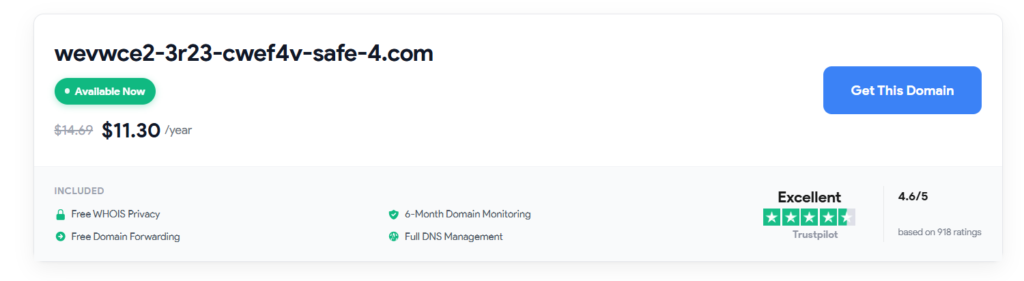
Screenshot: Atom.com
At this moment, wevwce2-3r23-cwef4v-safe-4.com can be registered through a domain registrar.
It can technically exist.
It can point to a website.
It can receive DNS settings.
It can host email.
It can be connected to a landing page.
It can be placed on a business card.
It can be used for a project, a test page, a private tool, an e-commerce store, an internal system, a temporary campaign or a non-public experiment.
In the most basic technical sense, it is a domain name.
But this is the easiest way to explain the difference between a domain name and a premium domain asset.
A domain name is not automatically premium because it can be registered.
A domain name is not automatically strategic because it works.
A domain name is not automatically valuable because it exists.
wevwce2-3r23-cwef4v-safe-4.com can technically function, but it does not automatically create trust, memory, category relevance, brand power or buyer confidence.
That is the difference.
A domain name can exist on the internet.
A premium domain asset can carry market meaning.
Why This Domain Is Not Premium
This domain is not premium because it is difficult to remember.
It is not premium because it is difficult to pronounce.
It is not premium because it is difficult to explain.
It is not premium because it contains random letters.
It is not premium because it contains random numbers.
It is not premium because it contains multiple hyphens.
It is not premium because it creates friction before trust begins.
It is not premium because it does not sound like a serious company.
It is not premium because it does not create clear brand identity.
It is not premium because it does not communicate a market category.
It is not premium because it does not communicate a product.
It is not premium because it does not communicate a service.
It is not premium because it does not communicate authority.
It is not premium because it does not communicate expertise.
It is not premium because it does not communicate credibility.
It is not premium because it does not communicate ownership of an idea.
It is not premium because it does not make the buyer feel safer.
It is not premium because it does not make the company easier to trust.
It is not premium because it does not reduce explanation.
It is not premium because it increases explanation.
It is not premium because a person would struggle to say it out loud.
It is not premium because a person would struggle to spell it correctly.
It is not premium because a person would struggle to type it without mistakes.
It is not premium because it is visually confusing.
It is not premium because it looks temporary.
It is not premium because it looks improvised.
It is not premium because it looks like a placeholder.
It is not premium because it does not look investor-ready.
It is not premium because it does not look enterprise-ready.
It is not premium because it does not look acquisition-ready.
It is not premium because it does not look suitable for a serious brand.
It is not premium because it does not support premium pricing.
It is not premium because it does not support a strong first impression.
It is not premium because it does not help a founder look serious.
It is not premium because it does not help a buyer understand the company.
It is not premium because it does not help a market remember the name.
It is not premium because it does not create linguistic authority.
It is not premium because it does not create category association.
It is not premium because it does not create strategic naming control.
It is not premium because it does not help the company own a clear idea.
It is not premium because it does not carry natural commercial meaning.
It is not premium because it does not create confidence before the website loads.
It is not premium because it does not create trust before the sales conversation.
It is not premium because it does not look strong in an email address.
It is not premium because it would look weak in a pitch deck.
It is not premium because it would create doubt in a procurement process.
It is not premium because it would create friction in word-of-mouth.
It is not premium because it would create friction in search behavior.
It is not premium because it would create friction in brand recall.
It is not premium because it does not help the business become easier to understand.
It is not premium because it does not make the company feel established.
It is not premium because it does not make the market feel that the name was chosen with discipline.
It is not premium because technical registration is not the same as strategic value.
The Real Lesson
This domain can technically work.
That is not the issue.
The issue is whether a serious company would want to build its public identity on it.
Would a founder use it for a serious startup?
Would an investor feel stronger seeing it in a pitch deck?
Would a buyer trust it faster?
Would a customer remember it?
Would a partner repeat it correctly?
Would a journalist write it naturally?
Would an executive place it in an email signature with confidence?
Would a company want to build five years of reputation on it?
If the answer is no, the domain may be technically usable, but it is not a premium domain asset.
Why Premium Domains Win
Premium domains win because they reduce friction.
They make a company easier to remember.
They make the brand easier to say.
They make the identity easier to trust.
They make the offer easier to understand.
They make the business look more intentional.
They create a stronger first impression.
They help the market place the company faster.
They help buyers remember the name after one exposure.
They help investors understand that the company takes identity seriously.
They help partners feel that the brand is built on a stronger foundation.
They help search behavior, word-of-mouth, email credibility, presentation quality and market perception work together instead of against each other.
A premium domain does not guarantee success.
It does not replace execution.
It does not create revenue by itself.
It does not make a weak business strong.
But it gives a serious business a stronger public foundation.
That foundation matters.
Because before the market reads your website, studies your offer, checks your proof or speaks to your team, it sees the name.
A domain is the first signal.
A premium domain makes that signal work for the company.
A weak domain makes the company work harder to overcome the signal.
That is the difference between a domain name and a premium domain asset.
This Is a Domain Asset
Now compare that with a domain such as:
SafeAccess.ai
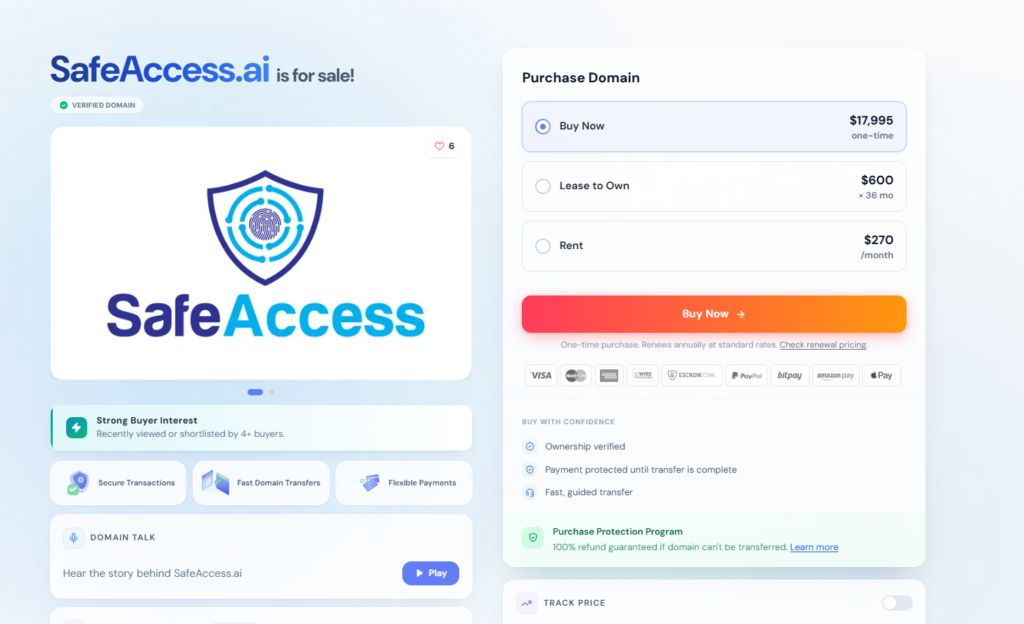
Screenshot: Atom.com
This is no longer just a random domain name.
It communicates something.
It contains recognizable language. It suggests security, access, protection, identity, systems, control, verification, authentication or digital trust. A buyer can immediately imagine what kind of company, product, platform or security-related service could be built on it.
That is where domain value begins to change.
A domain becomes more serious when it helps the market understand the idea before the website even loads.
SafeAccess.ai can function as a brand foundation. It can support a cybersecurity product, access management platform, identity system, secure login tool, enterprise security service, AI security layer, privacy product or trust-focused technology company.
The name does some of the work before the company starts explaining.
That is the difference.
A random domain requires explanation.
A premium domain reduces explanation.
If SafeAccess.ai is priced around $17,900 at the time of the screenshot, the price is not only about registration cost. The price reflects naming quality, market relevance, commercial use, buyer imagination, industry fit and the fact that a serious company could build a real brand around it.
It is not ultra premium.
It is not the final category killer.
But it is a domain asset.
It gives a buyer something usable: language, positioning, identity and commercial direction.
This Is a Strong Premium Domain Asset
Now look at:
Safe.co
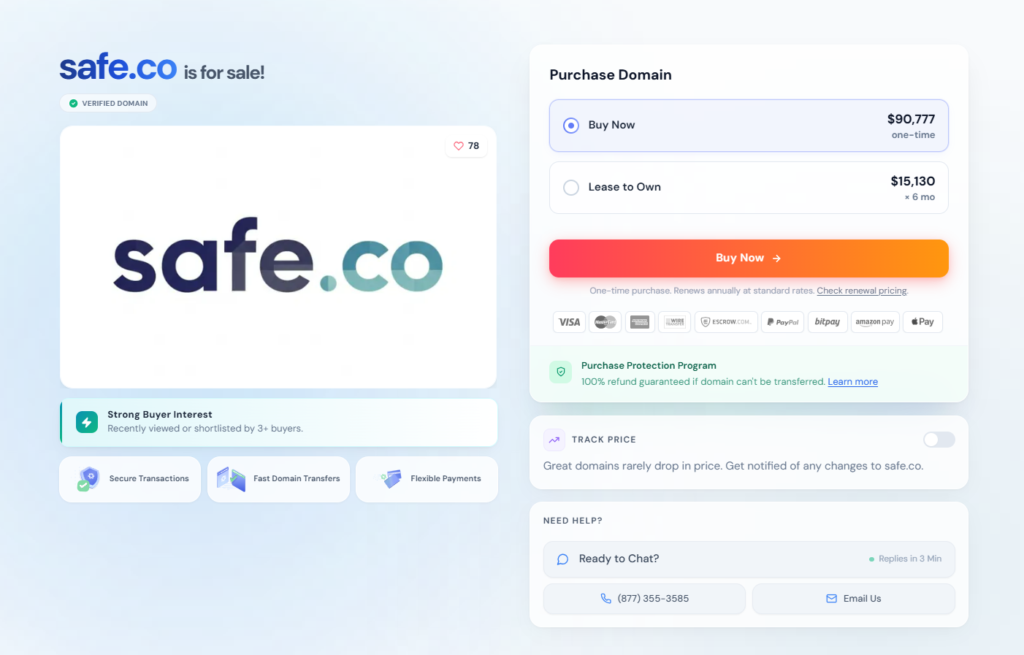
Screenshot: Atom.com
Safe.co is a very different type of asset.
This is a stronger type of domain asset.
It is shorter.
It is cleaner.
It is easier to remember.
It is easier to say.
It is easier to type.
It carries a broader meaning.
It can support security, insurance, protection, privacy, storage, identity, payments, health, family safety, fintech, digital trust, cybersecurity, personal protection or enterprise risk.
The word Safe is not narrow.
It is universal.
That matters.
A domain like Safe.co does not only describe one possible product. It opens multiple strategic directions while still keeping a strong emotional and commercial meaning.
People understand the word immediately.
Companies want to be associated with safety.
Buyers understand safety.
Investors understand safety.
Markets understand safety.
That is why a domain like Safe.co, priced around $90,000 at the time of the screenshot, sits in a different class from an ordinary domain name.
It is not just available internet space.
It is a compressed brand signal.
It can make a company look more serious from day one. It can strengthen investor perception. It can reduce naming friction. It can improve trust. It can make the brand easier to remember. It can carry a premium position before the company spends money explaining itself.
This is why premium domains win.
They reduce friction.
They create clarity.
They make the brand feel intentional.
They give the market a stronger first signal.
This Is the Ultra Premium Layer
Above that sits the ultra premium layer.
A domain such as:
Safe.com
Screenshot: Safe.com
Safe.com
would be a completely different class of asset.
This is what can be called a first-class category killer.
It is the exact word.
It is the strongest commercial form.
It is short, universal, trusted, memorable and category-defining.
It does not need extra explanation.
It does not need another word beside it.
It can represent a company, product, platform, security brand, insurance company, fintech product, privacy tool, family safety brand, digital protection service, enterprise trust platform or global consumer brand.
That is why ultra premium domains are not priced like ordinary domains.
They are not valued only as websites.
They are valued as strategic identity assets.
A domain like Safe.com would not only point to a website.
It could define the entire company.
It could become the brand.
It could become the category signal.
It could become the asset competitors wish they controlled.
That is the difference between a domain name, a premium domain asset and a category killer.
A domain name can technically function.
A premium domain asset can support a serious brand.
An ultra premium category killer can become the market identity itself.
The Search Result Test
There is also a domain such as:
3rdSafe-Access-In-New-York418.com
It can technically function.
It can point to a website.
It can publish content.
It can be indexed by Google.
It can appear in search results.
Under the right conditions, it can even appear near the top of Google for certain searches.
That is possible.
But technical visibility is not the same as market preference.
Imagine someone from Peru, Japan or Dubai searches for Safe.
They are not only looking at rankings.
They are reading signals.
They are asking, often without thinking consciously:
Which result feels serious?
Which name feels global?
Which name feels trustworthy?
Which name looks like it belongs to the category?
Which name would I remember?
Which name would I click if security, protection, access, identity or trust mattered?
A domain like 3rdSafe-Access-In-New-York418.com may technically appear in search results, but it creates limits before the user even opens the page.
It feels local.
It feels narrow.
It feels longer than necessary.
It feels harder to remember.
It forces the brand to explain itself.
It does not naturally feel like the center of the category.
That does not mean the website cannot rank.
It might.
That does not mean it cannot receive traffic.
It can.
That does not mean a real company cannot use it.
It can.
But if the user is thinking globally, comparing options and looking for trust, the stronger domain has the advantage.
The market does not only reward technical appearance.
It rewards clarity, memory, trust and confidence.
That is why a category-level domain wins.
Because when people search, they do not click only with logic.
They click with instinct.
They click the name that feels safest, strongest and most natural to trust.
Why a Serious Company Should Avoid a Domain Like This
A domain such as:
3rdSafe-Access-In-New-York418.com
can technically function.
It can point to a website. It can host content. It can receive traffic. It can appear in search results. It can be used for email. It can be placed on a landing page. It can operate like any other domain at the technical level.
But a company should not judge a domain only by whether it works.
A serious company should ask what the domain communicates before the website even loads.
3rdSafe-Access-In-New-York418.com creates friction immediately.
It is long.
It is difficult to remember.
It contains numbers.
It contains multiple hyphens.
It mixes generic words with location language.
It feels assembled, not chosen.
It looks like a backup option.
It does not feel like a strong brand foundation.
It does not create confidence before the click.
This matters because users do not see domains as neutral technical strings.
They see them as signals.
A domain like this can make the company appear temporary, local, less established, harder to trust and harder to remember. It may create the feeling that the company did not secure a stronger identity, even before the visitor understands the product or service.
That is the problem.
The company may be real.
The product may be good.
The team may be capable.
The service may be useful.
But the domain starts the relationship from a weaker position.
It forces the company to overcome doubt that did not need to exist.
A serious company should avoid a domain like 3rdSafe-Access-In-New-York418.com because it weakens the first signal. It makes the brand harder to say, harder to type, harder to trust, harder to repeat and harder to present in serious business environments.
Imagine placing it in an investor deck.
Imagine putting it on a business card.
Imagine sending an executive email from it.
Imagine asking a global buyer to remember it.
Imagine saying it out loud on a sales call.
Imagine a journalist writing it.
Imagine a customer in Japan, Peru or Dubai trying to decide whether this feels like the main company behind the idea of “safe access.”
That is where the weakness becomes obvious.
The issue is not only aesthetics.
It is market perception.
A weak domain creates questions before the company gets to make its case.
Why is the name so long?
Why are there numbers?
Why so many hyphens?
Why New York if the buyer is global?
Is this a local landing page?
Is this a temporary project?
Is this a lead-generation page?
Is this the real brand?
Is there a stronger company behind it?
Those questions may not be fair.
But the market does not always wait to be fair.
It reacts.
A premium domain reduces doubt.
A weak domain creates it.
That is why serious companies should avoid domains that make the market work harder to trust them.
The domain should support the brand, not become the first obstacle the brand has to overcome.
The Perceptual Node
Before a person clicks, the domain has already said something.
That moment matters.
A search result is not only a link. It is a small decision environment. The user sees a title, a short description, a brand name, a domain and maybe a few surrounding results. In a fraction of a second, the mind starts sorting signals.
Is this safe?
Is this serious?
Is this relevant?
Is this local or global?
Is this a real company?
Is this a temporary page?
Is this something I should trust with my attention?
That is the perceptual node.
It is the moment where the user has not yet read the website, tested the product, spoken to the team or reviewed the proof — but has already started forming a judgment.
Now imagine three domains appearing in the mind of the user.
Safe.com
The perception is immediate.
It feels clean. It feels strong. It feels direct. It feels like a primary brand. It feels global. It feels like the company may own the category. It creates very little friction. The user does not need to decode it. The word is already understood.
The mind sees Safe.com and thinks:
This is serious.
This is simple.
This is probably established.
This might be the main brand.
This feels like the center of the idea.
The domain does not need to explain itself. It arrives already loaded with meaning.
That is category-level perception.
Now look at:
SafeAccess.ai
The perception is different, but still strong.
It feels more specific. It suggests technology, access, security, identity, authentication, software, enterprise systems, AI, login, protection or controlled entry. It is not as universal as Safe.com, but it gives the user a clear direction.
The mind sees SafeAccess.ai and thinks:
This is probably a technology product.
This may relate to secure access.
This may be AI or software-related.
This sounds like a real product name.
This could belong in cybersecurity, identity, authentication or digital trust.
The domain creates a usable mental picture. The user can imagine the category. The name does not feel random. It reduces confusion.
That is premium asset perception.
Now look at:
3rdSafe-Access-In-New-York418.com
The perception changes immediately.
The user has to slow down.
The name creates cognitive friction. It feels longer. It feels local. It feels patched together. It contains numbers. It contains hyphens. It feels less natural to say. It feels harder to remember. It feels like it was assembled because better names were not available.
The mind does not say all of this in words.
It reacts faster than that.
It feels uncertainty.
It feels hesitation.
It feels lower trust.
It may wonder:
Why is the name so long?
Why are there numbers?
Why does it say New York if I am in Peru, Japan or Dubai?
Is this a local page?
Is this a lead page?
Is this a temporary website?
Is this a real brand or just a search result?
Should I click this, or is there a cleaner option?
This is the problem.
The domain may technically function.
It may even rank.
It may appear in the same search environment as stronger names.
But perception is not equal.
The user does not treat all domains as neutral addresses.
The user reads them as signals.
Safe.com creates authority before explanation.
SafeAccess.ai creates product direction before explanation.
3rdSafe-Access-In-New-York418.com creates doubt before explanation.
That is why domain quality matters.
A weak domain forces the business to repair perception after the first impression.
A premium domain begins with trust already moving in the right direction.
This does not mean the stronger domain automatically has the better product.
It does not mean the weaker domain cannot belong to a real company.
It does not mean the search ranking itself is worthless.
It means the domain changes the emotional and strategic starting point.
The stronger name starts closer to trust.
The weaker name starts inside suspicion, confusion or indifference.
And in digital markets, that starting point can decide the click.
The Moment the Market Starts Searching
Imagine the year is 2026.
Someone has just finished university and decides to build a serious software product around the idea of safety, protection, secure access, digital trust or identity control.
The idea is strong.
The ambition is real.
The person starts searching for the perfect name.
They look for Safe.com.
It is already taken.
That is the moment the difference between a domain name and a strategic domain asset becomes clear.
The founder can still register another domain.
They can register something random.
They can register something longer.
They can add numbers.
They can add hyphens.
They can add extra words.
They can use a weaker extension.
They can create a name that technically works.
But the question is not whether another domain can be registered.
The question is whether the market will trust it, remember it and click on it.
A random domain can technically rank in Google.
A weak domain can technically appear in search results.
A strange domain can technically sit beside stronger brands in the top 10 or top 20 results.
But when a person searches for something like Safe, they are not only reading rankings.
They are reading signals.
They are asking themselves, often without realizing it:
Which result looks serious?
Which name feels trustworthy?
Which website looks intentional?
Which domain feels like it belongs to the category?
Which brand would I click?
Which company would I remember?
Which name would I trust with security, identity, protection, money, privacy, access or personal data?
That is where premium domains win.
A domain like 05r8239-fww-fjfwo4.de can technically exist.
It can technically host a website.
It can technically publish content.
It can technically compete for visibility.
It may even appear in search results.
But it does not feel like the natural owner of the idea.
It does not create immediate confidence.
It does not reduce friction.
It does not make the market feel that the brand belongs in the category.
It forces the company to work harder before trust can begin.
Now look at the opposite situation.
If a serious buyer sees Safe.com, the name itself already communicates strength.
It feels direct.
It feels established.
It feels memorable.
It feels category-level.
It feels like the company had enough conviction, capital or strategic discipline to own the strongest possible identity.
That does not guarantee that the company is good.
It does not guarantee that the software is better.
It does not guarantee revenue, rankings or market success.
But it changes the first signal.
And in digital markets, the first signal matters.
The premium domain does not win because it magically replaces execution.
It wins because it makes execution easier to believe.
It makes the brand easier to trust.
It makes the company easier to remember.
It makes the product easier to explain.
It makes the investor deck stronger.
It makes the email address stronger.
It makes the search result stronger.
It makes the first click more likely.
It makes the market take the idea more seriously before the product has said anything.
That is the gatekeeping effect of a premium domain.
The best names are not just labels.
They are entry points.
They decide who looks serious before the conversation begins.
They decide which company feels native to the category.
They decide which result looks safe to click.
They decide which brand the market remembers after the search is over.
This is why someone may say:
“I do not care about the alternative names. I want this name.”
That statement is not always emotional.
Sometimes it is strategic.
The buyer understands that the name itself can become part of the advantage.
A premium domain can compress years of explanation into one clean signal.
A weak domain forces the business to spend years overcoming doubt.
That is why the stronger domain wins.
Not because the weaker domain cannot function.
It can.
Not because the weaker domain cannot rank.
It might.
Not because the weaker domain cannot host a real company.
It can.
The stronger domain wins because the market does not only evaluate websites technically.
The market evaluates trust, memory, clarity, authority and confidence.
A normal domain gives you a place on the internet.
A premium domain gives you a stronger position in the mind of the market.
And a category killer domain can make the name itself feel like the natural center of the category.
The Premium Domain Structure
Domain Name
→ technical access to the internet
Premium Domain Asset
→ trust before explanation
Search Visibility
→ the name appears inside a decision environment
User Perception
→ the buyer reads the domain as a signal
Market Confidence
→ the stronger name feels safer, clearer and more serious
Category Position
→ the domain feels closer to the center of the market
Strategic Result
→ domain quality becomes perception infrastructure
The Core Principle
A domain name gives you an address. A premium domain gives you a position in the mind of the market.
TheGatekeeping.com
© Index · System · Market Interface
Analytical Center for Digital Assets and Market Positioning